"(Translation) 蕩平碑"의 두 판 사이의 차이
장서각위키
(→Student 6 : (Write your name)) |
|||
| (사용자 10명의 중간 판 29개는 보이지 않습니다) | |||
| 1번째 줄: | 1번째 줄: | ||
{{Primary Source Document3 | {{Primary Source Document3 | ||
| − | |Image = | + | |Image = 영조탕평비1.JPG |
|English = | |English = | ||
|Chinese = 蕩平碑 | |Chinese = 蕩平碑 | ||
| − | |Korean = 탕평비( | + | |Korean = 탕평비(''Tangpyeongbi'') |
|Genre = [[Royal Documents]] | |Genre = [[Royal Documents]] | ||
|Type = | |Type = | ||
| 16번째 줄: | 16번째 줄: | ||
<gallery> | <gallery> | ||
| − | 파일:어제문업.JPG|link=( | + | 파일:어제문업.JPG|link=(Translation) 御製問業|I-1. 御製問業 어제문업(''Eoje munup'') 1774 |
| − | 파일:영조균역준천사업.JPG|link=( | + | 파일:영조균역준천사업.JPG|link=(Translation) 御製均役濬川卽予事業|I-3. 御製均役濬川卽予事業 어제균역준천즉여사업(''Eoje gyunyeokjuncheonjeugyeosaeop'') 1773 |
| − | 파일:영조어제일초복고.JPG|link=( | + | 파일:영조어제일초복고.JPG|link=(Translation) 御製壹初|I-4. 御製壹初 어제일초(''Eoje ilcho'') 1774 |
| − | 파일:영조어제수윤음.JPG|link=( | + | 파일:영조어제수윤음.JPG|link=(Translation) 御製垂綸吟|I-5. 御製垂綸吟 어제수윤음(''Eoje suyuneum'') 1774 |
| − | 파일:영조어제광탕서중.jpg|link=( | + | 파일:영조어제광탕서중.jpg|link=(Translation) 御製廣蕩|I-6. 御製廣蕩 어제광탕(''Eoje gwangtang'') 1774 |
</gallery> | </gallery> | ||
| + | |||
=='''Introduction'''== | =='''Introduction'''== | ||
| 27번째 줄: | 28번째 줄: | ||
=='''Original Script'''== | =='''Original Script'''== | ||
| − | { | + | {|class="wikitable" style="width:80%; font-size:110%; color:#002080; background-color:#ffffff;" |
| − | | = | + | !style="width:40%;"|Classical Chinese || style="width:60%;"| English |
| + | |- | ||
| + | | | ||
周而弗比 乃君子之公心<br/> | 周而弗比 乃君子之公心<br/> | ||
比而弗周 寔小人之私意 | 比而弗周 寔小人之私意 | ||
| − | } | + | 皇朝崇禎紀元後百十五年歲壬戌春三月二十六日手書命竪泮水橋傍. |
| + | 上八字是聖訓, 下十二子乃嗟今時勉來世之義也. | ||
| + | || | ||
| + | (Translation) | ||
| + | |- | ||
| + | |} | ||
| + | <!-- | ||
| + | |||
| + | =='''Discussion Questions'''== | ||
| + | # | ||
| + | # | ||
| + | |||
| + | |||
| + | =='''Further Readings'''== | ||
| + | |||
| + | <div style="color:#008080;"> | ||
| + | * View together with '''[[Record of Property Distribution among Brothers from 1621]]'''. | ||
| + | </div> | ||
| + | |||
| + | * | ||
| + | * | ||
| + | |||
| + | |||
| + | =='''References'''== | ||
| + | <references/> | ||
=='''Translation'''== | =='''Translation'''== | ||
| − | |||
| − | |||
| − | |||
| − | ==='''Student 1 : | + | ==='''Student 1 : Kim Young'''=== |
---- | ---- | ||
To be broad-minded and not take sides is the public-mindedness of a gentleman. To take sides and not be broad-minded is the selfish intention of a petty man. | To be broad-minded and not take sides is the public-mindedness of a gentleman. To take sides and not be broad-minded is the selfish intention of a petty man. | ||
| + | *Discussion Questions: | ||
| + | |||
| − | ==='''Student 2 : | + | ==='''Student 2 : Irina'''=== |
---- | ---- | ||
| + | Those who is open-minded does not make troubles | ||
| + | The noble man is devoted to the public interests. | ||
| + | Those who make troubles is not open-minded | ||
| + | He is devoted to his selfish aim. | ||
| + | *Discussion Questions: | ||
| − | ==='''Student 3 : | + | ==='''Student 3 : Masha'''=== |
---- | ---- | ||
| + | Document 2 All-embracing and not partial is a public mindedness of a morally upright person. Partial and not all-embracing is a selfish interest of a petty person. | ||
| + | *Discussion Questions: | ||
| − | ==='''Student 4 : | + | ==='''Student 4 : Jong Woo Park'''=== |
---- | ---- | ||
| + | Document #2 | ||
| + | |||
| + | Boundlessness and nonpartisan-ness are the characteristics of the superior men's public mindedness; partisan-ness and bounded are the characteristics of the lesser men's selfishness. | ||
| + | *Discussion Questions: | ||
| − | ==='''Student 5 : | + | ==='''Student 5 : Kanghun Ahn'''=== |
---- | ---- | ||
| + | The public-mindedness of the morally refined is to be universal, and not lopsided, | ||
| + | The private interest of the narrow-minded is lopsided, and not universal. | ||
| + | *Discussion Questions: | ||
| − | ==='''Student 6 : | + | ==='''Student 6 : Hu Jing'''=== |
---- | ---- | ||
| − | The public mind of | + | The public mind of a superior man is to be catholic but not partisan; while the selfishness of a mean person is the contrary behavior. |
| + | *Discussion Questions: | ||
| − | ==='''Student 7 : | + | |
| + | ==='''Student 7 : King Kwong Wong'''=== | ||
---- | ---- | ||
To be inclusive and not to be partisan is the public-mindedness of righteous men. | To be inclusive and not to be partisan is the public-mindedness of righteous men. | ||
To be partisan and not to be inclusive is the selfish intent of lowly persons. | To be partisan and not to be inclusive is the selfish intent of lowly persons. | ||
| + | *Discussion Questions: | ||
| + | |||
| − | ==='''Student 8 : | + | ==='''Student 8 : Zhijun Ren'''=== |
---- | ---- | ||
| − | |||
To reach everyone evenly and equally without getting intimate with a particular one is the public-mindedness of a superior man. | To reach everyone evenly and equally without getting intimate with a particular one is the public-mindedness of a superior man. | ||
To get intimate with a particular one without reaching out evenly is the private interest of a lesser mean man. | To get intimate with a particular one without reaching out evenly is the private interest of a lesser mean man. | ||
| + | *Discussion Questions: | ||
| + | |||
==='''Student 9 : (Write your name)'''=== | ==='''Student 9 : (Write your name)'''=== | ||
---- | ---- | ||
| + | *Discussion Questions: | ||
| − | ==='''Student 10 : | + | ==='''Student 10 : Martin Gehlmann'''=== |
---- | ---- | ||
| + | 周而弗比 乃君子之公心 | ||
| + | Well-rounded and not partial is the high-minded man’s public spirit | ||
| + | 比而弗周 寔小人之私意 | ||
| + | Partial and not well-rounded is the mean man’s self-serving intent. | ||
| + | *Discussion Questions: | ||
==='''Student 11 : (Write your name)'''=== | ==='''Student 11 : (Write your name)'''=== | ||
---- | ---- | ||
| − | + | Document 2 | |
| + | The virtuous man is open-minded and not factious. | ||
| + | The mean man is factious and not open-minded. | ||
| + | *Discussion Questions: | ||
==='''Student 12 : (Write your name)'''=== | ==='''Student 12 : (Write your name)'''=== | ||
---- | ---- | ||
| − | + | Being inclusive and not partisan is the public-mindedness of the superior persons. | |
| + | Not being inclusive and being partisan is the selfish mind of the mean persons. | ||
| + | *Discussion Questions: | ||
==='''Student 13 : (Write your name)'''=== | ==='''Student 13 : (Write your name)'''=== | ||
---- | ---- | ||
| + | *Discussion Questions: | ||
==='''Student 14 : (Write your name)'''=== | ==='''Student 14 : (Write your name)'''=== | ||
---- | ---- | ||
| + | |||
| + | *Discussion Questions: | ||
=='''Further Readings'''== | =='''Further Readings'''== | ||
| 103번째 줄: | 162번째 줄: | ||
* View together with '''[[정조 윤음 번역|(Translation) King Jeongjo, “Royal dictum to encourage farming” (Gweonnong yuneum 勸農綸音, 1781)]]''' | * View together with '''[[정조 윤음 번역|(Translation) King Jeongjo, “Royal dictum to encourage farming” (Gweonnong yuneum 勸農綸音, 1781)]]''' | ||
</div> | </div> | ||
| + | --> | ||
2022년 2월 14일 (월) 23:43 기준 최신판
| Primary Source | ||
|---|---|---|
 |
Title | |
| English | ||
| Chinese | 蕩平碑 | |
| Korean(RR) | 탕평비(Tangpyeongbi) | |
| Text Details | ||
| Genre | Royal Documents | |
| Type | ||
| Author(s) | King Yeongjo | |
| Year | 1742 | |
| Source | ||
| Key Concepts | King Yeongjo, | |
| Translation Info | ||
| Translator(s) | Participants of 2017 Summer Hanmun Workshop (Advanced Translation Group) | |
| Editor(s) | ||
| Year | 2017 | |
I-1. 御製問業 어제문업(Eoje munup) 1774
I-3. 御製均役濬川卽予事業 어제균역준천즉여사업(Eoje gyunyeokjuncheonjeugyeosaeop) 1773
I-4. 御製壹初 어제일초(Eoje ilcho) 1774
I-5. 御製垂綸吟 어제수윤음(Eoje suyuneum) 1774
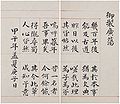
I-6. 御製廣蕩 어제광탕(Eoje gwangtang) 1774
Introduction
Original Script
| Classical Chinese | English |
|---|---|
|
周而弗比 乃君子之公心 皇朝崇禎紀元後百十五年歲壬戌春三月二十六日手書命竪泮水橋傍. 上八字是聖訓, 下十二子乃嗟今時勉來世之義也. |
(Translation) |

